Sunday, March 25, 2018

Woo Pig!

Il Porcellino


We often set some sort of goal for our travel days both to amuse ourselves and to offset the tendency to linger too long over morning coffee.  Today, our goal was to meet up with Il Porcellino in Sydney and say hello. Since our first visit with him in Florence, we have encountered him traveling around the world.  First, in Kansas City, then in Aix en Provence.  After leaving Victoria, CA and London, UK when found he was there.  We were sorry to have missed those visits.

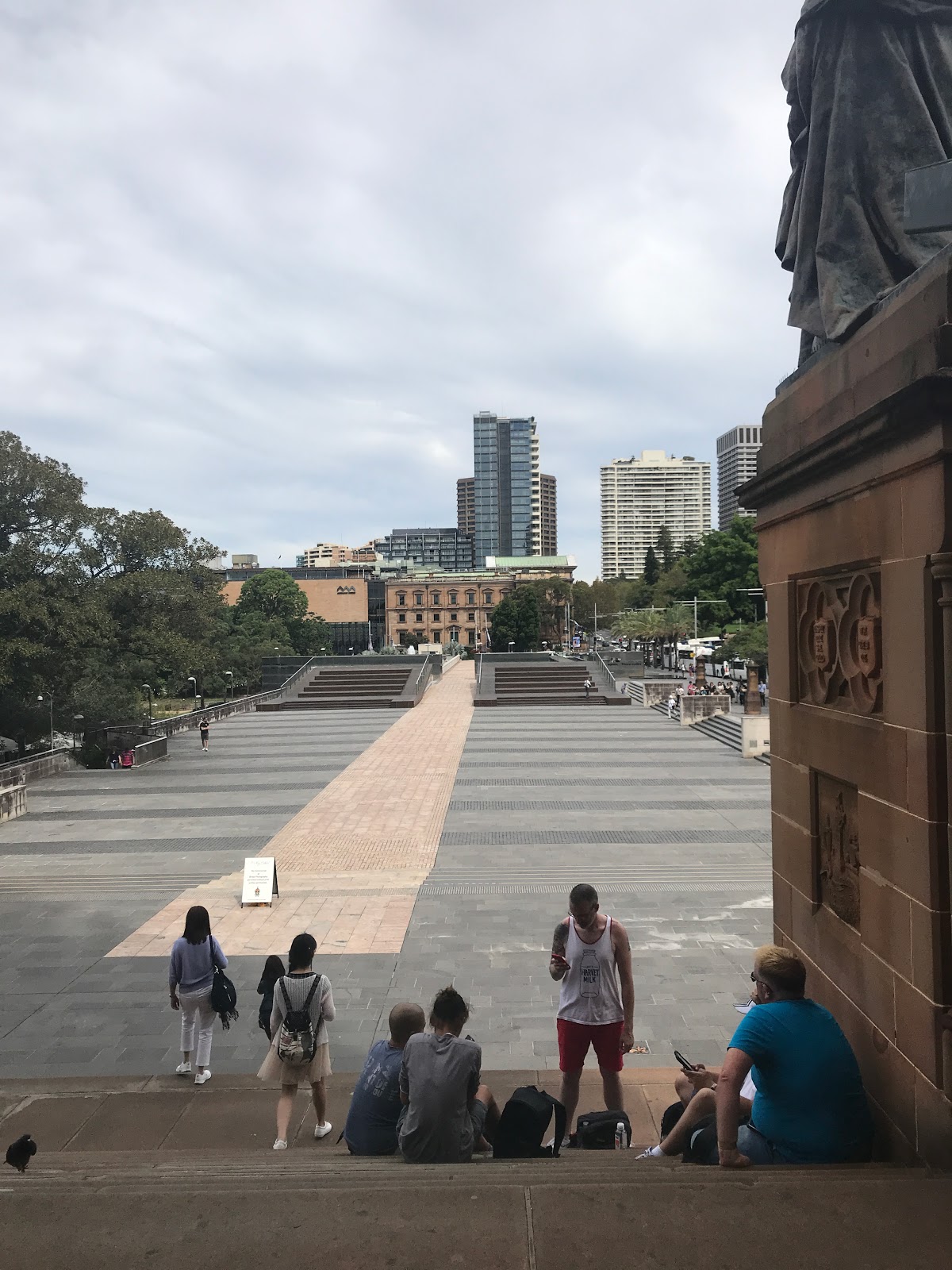
Sydney from St. Mary’s Cathedral

The remainder of the day was spent visiting St. Mary’s Cathedral and lunching at Blue Fish on Darling Harbor.  Earlier, we had eaten at Blue Fish with Road Scholar and really liked it.  This lunch was just as good: lemon sole, yum.  We walked 4 miles today, a beginning to get ourselves in shape after a month of catering by RS.  A few more pictures are at flickr.

Saturday, March 24, 2018

Sydney Settle In

Sydney from 57 York St Balcony

We will be spending the next 10 days in Sydney without any guidance.  I only hope we can reawaken the ability to find our way around, elect good restaurants and manage our time once again. Our apartment is in the Central Business District (CBD) of Sydney.  Check in was at 2pm, but we were able to drop our luggage at noon and explore the neighbor.  It appears to be a great area with many restaurants, high-end shopping and easy 20-25 minute walks to Darling Harbor, The Rocks and the Royal Botanical Gardens.  The first exciting thing that happened here was when the Uber dropped us at the apartment building.  Sirens began sounding, and an entourage of police cars and motorcycles
surrounding several black suvs approached and drove past.  OBAMA in the house.  We gave him the positive fist pump and felt elated.  He’s been in New Zealand where he received the Silver Fern and was at a private dinner in Sydney last night where he spoke.  I think his next stop is Japan?.? We so miss his class, decorum and sound family life that he brought to the office. Sigh.

Queen Victoria Building

One block over from the apartment is the Queen Victoria Building built in the 1890s, and which occupies an entire block. It is architecturally splendid; is full of boutiques, jewelry shops, restaurants, you name it and they have it.  We walked through it, had lunch, then shopped for food and returned to the apartment to settle in.  A very few photos are at flickr.

Friday, March 23, 2018

Au Revoir Road Scholar. Bon Jour Sydney

Novotel Cairns Oasis Resort

We had the morning free in Cairns before flying to Sydney.  I spent the time sitting by the pool.  It was a most interesting pool with one end sloped and full of sand like a beach.  Temperature and toleration have been interesting in the different regions we’ve stayed.  The sun was always very hot, but in the shade the winds were pleasant and you feel comfortable, even in the Northern Territory. It is Fall here, and that may account for the moderate winds. At the pool, I was in the shade under a canopy and very happy with the 80+ temps.

Our tour is coming to an end.  We all flew to Sydney this afternoon and had a last dinner together.  We were all at a long table toasting Heather and she us.  There are people with whom we would remain friends except for the great distances we live apart.  They will all fly off tomorrow to resume their respective lives.  W and I will sleep late, and take an Uber into Sydney proper.

Thursday, March 22, 2018

Up, Up in the Sky

Wayne in the Kuranda Bird World

From the sea to the forest. Our day was spent in the rain forest that grows above Cairns.  We traveled high into the mountains to Kuranda, a small village comprised almost totally of oodles of tourist shops and near the rain forest interpretive station.  Brian Clarke, our lecturer this morning and our guide through the forest is a most interesting man.  All his knowledge comes from personal observations, experience living in the forest and interaction. He dropped out of high school at age 16 and moved to the forest where he built and has lived in a cabin for the past 40 years.  He is one of the last professional crocodile hunters.  A short walk through the forest with him provided us with looks at the wet tropical trees and preceded a sky rail ride over the tops of the trees and back into Cairns.  On our walk we briefly experienced what rain is like in a rain forest...buckets worth of it that drowned out our voices.  Wayne and I used some free time in Kuranda to visit a bird Sanctuary where I couldn’t stop taking pictures.  

Tjapukai Aboriginal Cultural Park Performance

Our final adventure on this full day was a visit to the Tjapkai Aboriginal Cultural Park.  Like previous visits to indigenous centers, this felt a bit like being at Epcot.  There is an educational aspect to it, but...  There was a Sesame level performance of Aboriginal hunting dances, singing and didgeridoo.  We did get to try our skills at throwing a boomerang and a spear.  More training is necessary to pursue that activity.  

Time was taken with our dinner tonight to share our memories and highlights.  It’s been a great group.  No jerks, no smokers, only one childish woman who mostly provided laughs with her antics. Only one couple was late for the bus once (harumph, excuse us but we thought boarding time was 5:30 NOT 5:15). Everyone was retired and pursuing personal growth and interests. No one complained or groused.  90 percent were progressive Democrats. Many were outstanding in their professions (discovered through questions and deduction. No one bragged or made a point of their professional achievements) I loved learning so much about the earth’s formation, the flora and fauna and seeing the land.  My suggestion was to have Aboriginal lecturers that balanced the information.  Pictures of beautiful birds and other things at flickr.

Wednesday, March 21, 2018

Where’s Nemo?

Leaving Port in Cairns

A brief observation about touring.  It seems that when people travel in a tour group they loose all sense of their abilities.  Even though everyone in our group has traveled extensively and all over the world, there are still those who ask questions about the simplest procedures in upcoming adventures.  Dave, our guide to the Great Barrier Reef, did his best in last night’s lecture to cover all the bases. He had pictures of the boat; he demonstrated the use of a snorkel; he showed pictures of the island, of the boat, of the Reef.  Still, the questions came: how do you clean the snorkel?, how many steps to the boat?,  how long is the boat?, how wide is the boat?, where will we change?, will the sharks attack?  No, really, some of those are exaggerations.  But it is as if a tour sneaks into a person’s brain and destroys the adult cells.  Brian finally said,”I’ll take further questions one on one.”  


Michaelmas Island 

The Great Barrier Reef is not exactly on the edge of the coast.  It was a 2.5 hour ride out to Michaelmas Island.  Brian refers to it as his office.  The island was formed when the coral grew up to the level of the water.  Then, sand and plants began to accumulate on it.  It is now a protected area for hundreds of sea birds.  They (the birds) allow humans a landing zone.  We were tendered over, where we put on our flippers and immediately were swamped by the surf.  This is the first time I have had to wear flippers and maneuver into deep water.  It is a butt-on-sand move.  In the past, a boat has just dropped me at the snorkel site.  Here, we had to swim out about 75 yards to reach the first reefs.  But what a treat the swim presented!  One guy on the boat got a ride with a turtle.  Wayne saw the best of the fish and reef as he swam out farther than me.  In fact, the life guard motored out to him and suggested he turn back.  


Semi-Submersible

We also had a ride on a semi-submersible boat.  We sat below water while the boat toured among the reefs and Dave describe the different corals and fish. The water was a bit cloudy due to recent storms.  Pictures of the day at flickr


Tuesday, March 20, 2018

Many Heads


Ghost Gum Trees

The resort we have stayed in is surrounded by the Ghost Gum tree, one of the many eucalyptus trees that grown here.  It has a smooth bark that is strikingly white.  Out in the park area are blonde grasses that the green desert oak sit in.  The blonde grass, the green trees, the red rock and the blue sky help me understand why Georgia O’Keefe left NYC for Arizona. 


Kata Tjuta


Before leaving the Red Center for Cairns, we first traveled out to Kata Tjuta, Many Heads in English.  It is a spectacular formation of 36 rounded domes.  At the look out platform where one can get a good look at the entirety of Kata Tjuta, a glance around also reveals the nearby Uluru.  I appreciated this formation more than Uluru.  It was made up of well rounded boulders that form deep narrow valleys among them.  We hiked up a long the sloping area to Walpa Gorge and a water hole.  As we climbed up we had wonderful views of the Outback.  There were conglomerate boulders along the way that looked like they had been tossed to the ground by Giants.  Once again at the waterhole the temperature was cool and refreshing as opposed to the 100+ degrees we walked through.  All the guides insist that we drink a pint of water an hour and apply sun block every two hours.  Most of them wear long pants and long sleeved shirts.  

Flying Foxes

Back at the resort we had lunch and prepared for our flight to Cairns, on the east coast.  It was quite a change in one day from the desert to the tropical area of Cairns.  We are so delighted to have trees full of hanging flying fox bats outside our hotel room balcony.  The locals have little use for the squawking and pooping the bats provide.  But they are endangered and left alone...yea!  Tonight we had a lecture from a marine biologist, Dave O’Brien, on the Great Barrier Reef.  He gave insights into what we might see tomorrow on our cruise and snorkeling adventure at this World Heritage site.  Hundreds maybe even thought of pictures of Kata Tjuta are at flickr.


Monday, March 19, 2018

I Rode to the Desert on a Bus with No Name....

Wayne and Christy at Uluru

We left Alice springs today for the Uluru and Kata Tjuta National Park where we will spend a day and a half.  The drive there was 6.5 hours but the scenery so interesting it was fun.  We also took a break at Stuart’s Well Camel Farm where I took a ride on a camel.  It was a very short ride with a very bumpy run at the end.  I feel my camel riding desires are satisfied.  

Upon arriving at Uluru, we took two long walks led by Martin who gave an explanation of the Aboriginal significance, the flora and fauna and geology. Uluru is 1100 feet high, 2.3 miles long and 1.5 miles wide.  The monolith is truly a gray sandstone. But the iron in the stone has weathered and turned the rock red due to oxidation.  During the many years of geological time and earth movement, the sediment beds of Uluru were forced up and out at an 85 degree angle.  It is unknown how much more of Uluru remains deep in the earth.  It was on these walks that we saw the desert art mentioned in a past posting.  

After dinner we returned to Uluru for a sunset viewing.  Road Scholar had a reserved area with stools and champagne for us to see the icon in its purple sunset robing.  It is during the sunset that the Aboriginal women sit along the edge of the road selling their Papunya paintings.  I was looking at one woman’s work having decided to buy.  Because I was holding my iPhone, she accused me of video taping her and continued to accuse and lecture me even after I denied it.  I left at that point for the sunset viewing area.  Suddenly, she was behind me asking to look at the phone.  I eventually convinced her I did not video her or take her picture.  The odd thing was she had been allowing videos once someone bought a painting and posed with her.  Shrewd business woman?  Or maybe not.  She lost my business.  Hundreds of camel and Uluru pictures at flickr.

Sunday, March 18, 2018

Yes, Deserts Have Parks

Alice Springs Desert Park

We left early this morning for the Alice Springs Desert Park.  When in the desert, go early.  Martin, our site-coordinator led us along the marked areas and pointed out indigenous flora and fauna.  What has surprised me here is how green it is, how many large trees there are and how much water there is. It is a land of droughts and flooding rains with a yearly average rain fall of 10 inches. There was a great aviary and nocturnal house where we saw marsupials and reptiles that only come out at night and got our first sighting of an Australian bat. I was constantly seeking shade as we stopped to talk about species.  I’m really still amazed that trees can live here. The majority of trees are eucalyptus and desert oak (which is not an oak at all but named by settlers).   I learned about the witchetty grub that lives among and eats the roots of the acacia shrub.  The aboriginals eat them.  I was inspired later to buy a piece of aboriginal designed cloth with witchetty grubs on it.  This was the first day we needed to wear our bug nets.  The little black flies were after us. 

Simpson’s Gap

After lunch we traveled to Simpson’s Gap which is in the MacDonnell mountain range that surrounds Alice Springs.  We hiked into the Gap where a permanent waterhole sits under the towering cliffs. Black-footed wallabies live here. This place was the Aboriginal mythological home of a group of giant goanna ancestors and remains a spiritual site to them. Aboriginals have Dreaming stories that explain how they and the world came to be.  These stories are tied to the land.  At Simpson’s Gap, Martin pointed out specific marks, ridges, holes in the cliff that told the story of the giant goannas.  It’s a fascinating culture.  

We left Simpson’s Gap for the Royal Flying Doctor Service to see how they accommodate people/patients who are so very far from medical services.  This stop was likely one of Road Scholar’s attempt to support a local endeavor.

Tonight we had the most interesting of dinners at Kongkas Can Cook.  We learned about and ate Aboriginal traditional bush foods. No witchetty grubs, but we did have kangaroo. Many of the berries and seed are so potently savory.  Ray Lee Brown of Aboriginal decent owns the restaurant and is determined to make a go of this industry through employing Aboriginal women to gather and protect the plants. Pictures at flickr.


Saturday, March 17, 2018

You Say It’s Your Birthday

The walk into Alice Springs (102*)

We took a 2 hour flight from Melbourne today to Alice Springs which is just about in the smack dab middle of Australia.  Most blokes around here call it the Red Center.  We know it better as the Outback.  It is a very ancient land.  The hills surrounding Alice are made of rock formed about 1800 million years ago.  It’s bloody hot here, too.  They may say it’s fall but it was 99 degrees when we landed.  This area has been home for Aborigines for 30,000 years.  The physical characteristics of the land have cultural significance to the Aborigines, which is the main reason they will not live elsewhere.  Because they will not leave the land their economic situation remains pretty dire.

Martin Ludgate, the Perfect Aussie

Our site coordinator here is Martin Ludgate, and like all previous site coordinators he has a passion for and a deep knowledge of the area.  On the bus from the airport, Martin gave us some information about the area.  Before the Aboriginals arrived there are no other signs of a people such s Neanderthals living here.  It is believed now through DNA that the Aboriginals came down through India.  First White contact came around 1870 when the telegraph lines were being laid.  Some of the tribes in the Outland areas did not have contact until 1950-60.

School of Air

After lunch we went to the Alice Springs School of the Air.  Had I realized (in other words paid attention) the coach would return to the hotel for a lecture, I would have skipped this trip.  It was just to show us how long-distance learning was developed and used for kids that lived hundreds of miles from Alice on the cattle ranches.  Road Scholar generally tries to support cultural and civic organizations through visits and gift shops.  I think this was one of those supports.

Paunch art with Witchetty Grub

Our lecture was on Aboriginal Culture and Art in Central Australia.  The majority of the art consists of hand stencils in caves with ochre to depict ancestors and to claim land.  There are rock carvings on sandstone and paintings with white clay.  The best know Aboriginal artist to paint in a western style is  Albert Namatjira  The region is noted for its Papunya art, dot painting.  The Papunya Tula Artists is a cooperative formed in 1972 that is owned and operated by Aboriginal people of the Western Desert.  These paintings tell the Dreamtime creation stories.

The Alice Springs Trio

Tonight we had dinner and entertainment at the Olive Pink Botanical Gardens Cafe.  It was perfect timing to celebrate Wayne’s birthday.  We had a traditional steak on the barbie and song from Barry Skipsey.  Wayne had to perform with Barry on the Lagerphone.  I laughed until tears came.  Have fun with this at flickr.

Friday, March 16, 2018

Arts Longa, Vita Brevis

Dr. Pullin with The Sheep Shearers

Our lecturer this morning was Dr. Ruth Pullin, an expert on colonial artist Eugene von Gerard.  She provided insight on the development of art in Australia as a documentation of the fauna and flora by convicts and settlers for the British comparing it to the Hudson River School.  Some of the art was greatly romanticized in order to encourage settlers from Britain.  After the lecture we walked to the National Gallery of Victoria where Dr. Pullin acted as docent.  Two current exhibits rounded out the learning. 1) 600 early works illustrating the history of the settlement. 2) current works by Aboriginals depicting the horrors inflicted upon them by the settlers.  

We had dinner this evening with Nancy and Jerry Cutler, Road Scholars from Florida and Connecticut.  We all love Greek food and what better place than Athens than Melbourne.  The dips were delicious as was the octopus.  To my disappointment there was no spanakopita, but the fried feta with honey made up for it.  Pictures of our day at flickr.

Thursday, March 15, 2018

March of the Penguins

Melbourne Laneway

We had the most marvelous walk this morning through Melbourne’s famously funky laneways.  I would call them galleries as they are covered pedestrian streets. We walked through about 4 or 5 of them before we ended back at our start.  They have a very British feel with tea rooms and hat shops.  After the walk we hopped on a tram for a ride to the Queen Victoria Market, or Vicki’s as the locals call it.  The Central Business District (CBD) has a free tram system.  Cool!  Oh yeah, back to Vicki’s place.  It spreads over two city blocks and has what you would expect: fish of every variety, meat of every variety, cheese, sausage, fruits, vegetables.  We loaded up on, you guessed it, cheese and sausage.  

Phillip Island

This afternoon we rode to Phillip Island, a sanctuary island that was once a community of holiday homes.  At one point, the government realized the unique and fragile quality of the island and began to buy out the homeowners.  Eventually all the homes were purchased  torn down.  The coast line is beautiful: rocky and wild.  We took a board walk along the coast line where there were penguin box nests.  When the houses here were torn down, penguins were found to be nesting under them.  The park service built little ground boxes for them in place. They continued the practice along the coast.  As night fell we gathered at the beach and watched hundreds of the Little Blue Penguins come ashore and walk past us to their burrows.  What a sight!  Pictures of everything but penguins at flickr. They are not allowed.


Wednesday, March 14, 2018

Melbourne, Or Milburn As They Say

Melbourne

We left New South Wales this morning on a flight to Melbourne in Victoria.  Larger than Sydney in the past, today Melbourne is a bit smaller but growing daily.  Physically it appears different with extensive parks and gardens set among the city streets and buildings that were built during the gold rush era. It is reputed to have the largest Greek population outside Athens.  

Shrine of Remembrance

Our first stop was the Royal Botanical Gardens for lunch, a stroll through the Gardens, and then a visit to the Shrine of Remembrance, a National War Memorial.  The Aussies are big on big memorials for WWI, WWII and Gallipoli.  

Our site coordinator here is Richard De Gille.  He is a practicing lawyer and about as far to the left as one can be.  Wayne loves him.  He regaled us with information about Melbourne and Victoria peppered with his opinions about what could be better.  I thought he was a bit critical, but then began to appreciate what he was critical of.  

Photo Bombed in Eureka Skydeck

Our final stop was at the Eureka Tower where we headed up to the Eureka Skydeck 88 on the 88th floor.  It offered a 360 degree viewpoint of the city including the river Yarra winding throughout.  It didn’t beat the Sears/Willis tower, our highest experience.  On the way to the hotel we spotted the Rod Laver stadium where the Australian Open is played. Pictures are at flickr.


Tuesday, March 13, 2018

The White Man’s Perspective

Bondi Beach, Sydney

At each stop we have at least one and sometimes two lectures to begin our day and give insight into either an area we will visit or more broadly a geological, political or cultural aspect.  They are in depth, lasting approximately 1.5 hours.  (The tea break goes without saying).  The lecturers are highly regarded in their area sporting multiple degrees and years of experience.  This morning our lecturer was Robert Lee, Professor of History. After a few minutes of listening, I suggested he should have been named Robert E. Lee due to his very one sided presentation on race, religion and politics.  For example, he said he would have no problem with commemorative memorials to slain soldiers no matter what their cause.  (Hitler?  Really?). Muslims were okay as immigrants as long as they were nominal Muslims.  You get the drift.  The group seemed to have the same consensus and expressed a wish for the Aboriginal point of view to balance the lecture.  


Archibald Memorial Fountain designed by Sicard, Hyde Park, Sydney

Following the lecture we rode to an area of north Sydney known as Bondi.  It is a beach suburb with pretty decent surf and a view of the Harbor entrance.  We had lunch there and were set free back in Sydney proper to explore on our own.  Personally, I could have skipped Bondi and explored all day.  Wayne and I decided to walk through Hyde Park in search of the fruit bat.  Alas, no bats were found, but a pretty fancy fountain was.  Later, we had dinner on our own back in Darling Harbor at a place called Little Snail.  Wayne resurrected his French side and we ate all appetizers of snails, calamari and a bouillabaisse.  Pictures at flickr.


Monday, March 12, 2018

It’s All Happening At The Zoo

Cassowary at the Taronga Zoo

This morning we drove over the world’s widest expansion bridge to the Taronga Zoo.  We had a very knowledgeable volunteer docent guide us through the high lights of the Zoo.  As northern hemispherians (I made that word up) we only had eyes for the kangaroos, koalas and wallabies as well as the wombat, echidna and the fabulous, unbelievable duck billed platypus.  It truly was fun and there was a aviary chocked full of colorful birds one of which liked blonde hair.  So, our friend Beth provided her curls for nest building.  Most of the large animals such as lions, elephants, giraffes have been moved to a safari type park.  

Sydney Opera House

Our return across the Harbour to the Cove was by ferry where we visited the Sydney Opera House.  An Opera House guide told the story of the concept, the development and the long road to completion of this masterpiece.  Sadly, the architect was dismissed before completion and returned to his native Denmark never to see the House open and performed in.  We went into the larger performance area where we watched and listened to an orchestral practice session. The operas are performed in the smaller hall.  

La Traviata at the Sydney Opera House

This evening we returned to the Opera House for a performance of La Traviata.  Our seats were great as was the performance.  After, as we were hanging outside waiting for the group to coalesce, the male star happened to walk past and stopped for photographs. 
Photos at flickr.


Sunday, March 11, 2018

I’ll Have Mine On The Rocks

Wayne in The Rocks with the Sydney Harbor Bridge

This morning we took a coach ride up to an area in Sydney known as The Rocks.  Beginning at the base of the Sydney Harbor Bridge, we walked along Sydney Cove which area was walled and filled by convicts and today offers sanctuary to the large cruise ships.  The bridge was built during the depression and, despite appearances, is the world’s widest long span bridge.  There is a walk way on the top most span that you may traverse.  Over and back will take 4 hours and nerves of steel.  The Rocks sits up and behind the Cove and was the area of Sydney first settled by the British.  Today it still retains many of the Colonial buildings.  On Saturday and Sunday the streets become an open market area for art, crafts, food and music.  We were fortunate to be there on a Sunday.  We had lunch in one of the oldest buildings that was once the hospital, Scarlett.  The name, however, was taken from the abode down the street where women of the evening conducted business.  


Cruising Sydney Harbor

After lunch we walked back to the Cove where we boarded a small vessel for a cruise on Sydney Harbour.  The Harbour is stunning and expansive.  I have never seen so many boats of every type vying for water and wind.  I was amazed no collisions occurred.  

Darling Harbor Pedestrian Bridge

This evening we walked from our hotel to the Darling Harbor area, which feeds into Sydney Harbor.  My eyes were huge, my mouth hung open and oohs and ahs were exclaimed.  I really cannot convey what a magnificent area Darling Harbor is.  A mixture of multiple nationalities mingled there; large new buildings soared above the wide boulevard-like pedestrian way; it’s very cosmopolitan.  The Harbor is small enough to easily see across and take in the whole of it.  Restaurants abound and a pedestrian bridge caps the delight of the area.  We walked across the bridge after dinner, in the dark, marveling at the lights, sounds and vitality of it all.  Pictures at flickr.


Saturday, March 10, 2018

G’Day Mate

Wellington Coast 

Before departing New Zealand we took a morning field trip to the coastline to see how tectonic forces have shaped the environment surrounding Wellington.  As I told you, there are an average of 8 earthquakes a day here.  Our guide was Dr. Hamish Campbell.  Yes, he is a Scot and an expert paleontologist.  He is currently involved in volcanology and paleontology research in Australia, Thailand and the Chatham Islands.  He talks in terms of billions of years.  As we walked along the coastline with him, he pointed out the tectonic faults in the cliffs.  Clear lines of demarcations and layers of granite and sandstone were visible.  We picnicked on the coast and then headed for the airport.

Upon arrival in Sydney, we met our next Site Coordinator, Brian, who described the scene of our drive to Darling Harbour.  Prior to retirement, Brian worked for Qantas Airways.  He also worked on the Sydney Olympics Committee.  

Our hotel is located very near the Darling Harbor which flows into the Sydney Harbor.  It is an extremely vibrant area filled with restaurants, a convention center, a pedestrian bridge and people galore.  In the other direction is China Town.  We are in a great area.  Pictures at flickr.


New Zealand: Thoughts, Sounds and Interesting Things

Interesting to Us
1.  There are no screens on windows here.  
2.  There are few places with air conditioning, including restaurants and supermarkets
3.  You never get a check at your restaurant table.  You just go to the cashier and they miraculously know what you ate and how much you owe.  It eliminates prolonged waiting and the tipping dilemma.
4. Bugs are everywhere.  Locals claim the unusual prolonged rains are to blame.  We were inundated with an influx of flying crickets one night, cicadas last night.  See #1
5. From the accent to the environment, sounds are so different here.


My blogger skills are limited to the amateur level.  If you want to hear some sounds we recorded you will need to select the link below and then download each one.  
New Zealand Sounds

Friday, March 9, 2018

Zealandia

Kaka Parrot

New Zealand struggles with protecting indigenous flora and fauna.  There are many species that have become extinct due to invasive plants and mammals.  In fact, NZ has only one native mammal, the bat.  Near Wellington is Zealandia, a sanctuary of native forest and lakes.  About the size of Manhattan, Zealandia is completely encased in a perimeter fence that excludes all introduced predators which have been eradicated within the borders.  Traps are set throughout the preserve simply to monitor the possibility of predators.  When asked about captures, our guide said, “None have ever been trapped.  If that happened there would be complete panic and breakdown.”  We hiked for about 2 hours observing mostly birds and flora.  The most interesting were the giant parrots, kakas.  They are not as vividly colorful as the South American, but have a more subtle feather display. Zealandia is located on a high hill near an area that was developed in the early 1900s for expensive homes. A cable car system was built to accommodate those living there with easy access to the town center.  After our Zealandia hike and the mandatory morning tea, we rode the Wellington Cable Car down to the city center. The ride gave us an excellent view of Wellington Harbour and its hilly backdrop.  It reminded me of our cable car rides in Lisbon.  

Te Papa Tongarewa Museum 

This afternoon we walked to Te Papa Tongarewa:  National Museum of New Zealand.  We had a docent led tour that introduced us to the key displays of Mauri.  Our docent was a Mauri, who added her personal experiences to the explanations of sculpture and houses.  One section of the Museum has a modern interpretation of the meeting house.  Mauri actually use the space for ceremony.  Also, at the museum was an exhibit, Gallipoli, illustrating the battle with tripled life size sculptures of soldiers as well as video and text.  

Tonight is our last night in New Zealand; tomorrow we fly to Sydney, Australia.  After dinner each person in the group told of there best experience/memory and offered suggestions for Road Scholar to consider.  Pictures at flickr.


Thursday, March 8, 2018

The Ayes Have It

Supreme Court, Wellington

Armed with all our knowledge from last night’s lecture, we took off this morning to visit Parliament.  Parliament was not in session. The House looks very much like Britain’s House of Parliament.  Currently there are 5 parties with the Labor party forming the largest coalition.  From Parliament we walked to the nearby Supreme Court, which has been in existence only since 2004. Prior to that the right of appeal was held at the Privy Council based in London. There are only 5 judges.  The public can view court proceedings from behind a viewing glass without appointment.

The Wellington National Portrait Gallery

After lunch we were free to explore on our own.  Wayne and I went to the New Zealand Portrait Gallery where we saw this year’s chosen work from a juried show.  The works were quite nice and varied.  From the Gallery we walked along the harbor, explored a local market and then went to dinner with some from the group.

Foe, Jennifer, Wayne, Christy Healther, Betty

More pictures of the day are at flickr.


Wednesday, March 7, 2018

Back North to Wellington

Plane Table Lookout

Time for our whorl-wind tour to move on for Wellington today.  We first took a drive up to Plane Table Lookout for a view of the Gibson Valley,  Once again, the climb up in the coach was breath taking.  We were actually in the clouds and didn’t get a clear view of the valley.  It was eerie, though.  As we descended the clouds broke for great views of the valley.  Ian, our poetic leader, said he thought the clouds were going to hold us in Queenstown but now they’ve decided to release us.  Down in the Gibson Valley we stopped at a winery and cheesery, then a short stop to watch the crazy people bungee jump, and finally headed for Arrowtown.  


Arrowtown is a former gold-mining settlement.  This area of New Zealand had a major gold rush following the California gold rush.  Ian said there is no gold to be found on the surface any longer.  Only deep excavations currently produce.  Today, the little 150 meter town has become an upscale tourist stop with high-end clothing stores and restaurants.  There is a mixture of Marino wool and possum fur used here that makes the softest, most beautiful clothing.  The New Zealand possum looks nothing like the American Possum, and the fur is silky.  But most sweaters are around $400.  My memory of the feel will suffice.  


Flying to Wellington

This afternoon we boarded our 2 hour flight for Wellington.  Wellington has been the capital of New Zealand since 1865.  It sits on an amphitheater-like harbor formed by the flooding of the crater of a very large and long extinct volcano.  Rugged hills surround the harbor where its distinctive wooden houses (which have drawn parallels with San Francisco) perch precariously.  Wellington is the home town of Peter Jackson.  I’ll keep my eye out for hobbits. Pictures at flickr.


Tuesday, March 6, 2018

A Victorian Voyage to a Sheep Shearing

Aboard theTSS Earnslaw
This morning we sailed aboard the coal-fired vintage steamer TSS Earnslaw to Walter Peak Station.  The Earnslaw, locally known as the Lady of the Lake, was build in 1912 and is the only coal-fired passenger-carrying vessel in the Southern Hemisphere.  Her steam engines could be seen from an open viewing area on the second deck where they were kept running on one ton of coal an hour.  We’re pretty sure that was clean coal, though.  There was a definite air of the Victorian period aboard.  Live music was provided by a female pianist in proper attire, the coal engine was being fed manually, and the captain was in full uniform regalia.  I just needed my bustle to feel complete.  Our destination was the Walter Peak High Country Farm across Lake Wakatipu for lunch, sheep shearing and sheep herding.  This presentation was very commercial with about 200 adults and 2,000,000,000,000 kindergarteners watching the shearing on stage in a half-shell.  The dog herding was held outside.  But was only about a 3 minute demonstration of herding 5 sheep into a small pen.  Our look at herding in Ireland was so much richer and in-depth with only about 15 of us watching across a fence as the dogs performed various tasks for about 30 minutes.  The farmer stood with us explaining each whistle, finger snap and call for the dogs.  


Our afternoon was free, which we relished.  Free that is until the fire alarm forced us to vacate the hotel.  We were allowed back inside after about 30 minutes with no explanation.  Pictures are at flickr.

Monday, March 5, 2018

Milford Sound and Queenstown

The Chasm, Near Milford Sound

We have now experienced “You can’t get there from here”.  But, the getting there and back again was a delightful drive through the most scenic splendor.  The area is called Te Wahipounamu... but you can just call it Fjordland.  It is South West New Zealand, a UNESCO World Heritage-listed landscape.  Rather than trying to describe the magnificent mountains and the gorgeous plains, I’ll just suggest you linger over my photos and image something 10 times better.  As our new site coordinator, Ian said.  “I love to watch what mood the mountains will reveal each day.”  Our destination from Te Anau was Milford Sound, a two hour drive north where we took a cruise through the sound out towards the Tasman Sea.  The weather has been very kind to us and was again today.  The Sound is actually a fjord created by glaciers.  We made a few photo op stops and a small hiking stop through The Chasm.

Queenstown from Bob’s Peak

Next stop was Queenstown.  But you truly cannot get there from Milford Sound.  So...back south to Te Anau, turn left and head north for another 2 hours. Queenstown is not a favorite of our guides because it is a tourist town.  They prefer the more remote areas where tramping (hiking) is best.  We’re okay with Queenstown because our hotel it top notch and the WiFi is fast.  We have a good view of Lake Wakatipu and had dinner on Bob’s Peak accessed by a gondola.  Let me add here that at all but one stop we have had 5 star meals.  Tonight’s offering was buffet style with every meat, fish and vegetable one could want.  The tuna sashimi was the best I have ever tasted. Photos at flickr.