Saturday, March 3, 2018

Akaroa Harbor

View of Akaroa Harbor

This morning we took a coach out to Akaroa on the Banks Peninsula. It was about 1.5 hours  drive through historic settlements of the Maori, French and other Europeans.  Akaroa is a historic French and British settlement nestled in the heart of an ancient volcano.  The Akaroa harbor was once a lake.  But two volcanic eruptions opened the lake to the Pacific Ocean.  Because the French were here, there are roads and areas with French names.  Canterbury (where Christchurch and Akaroa are) is called a Parish.  At one time all of the area was covered in trees.  Today, it is mostly grasslands.  All the trees were cut for exportation and local building.  

Cruising the Akaroa Harbor

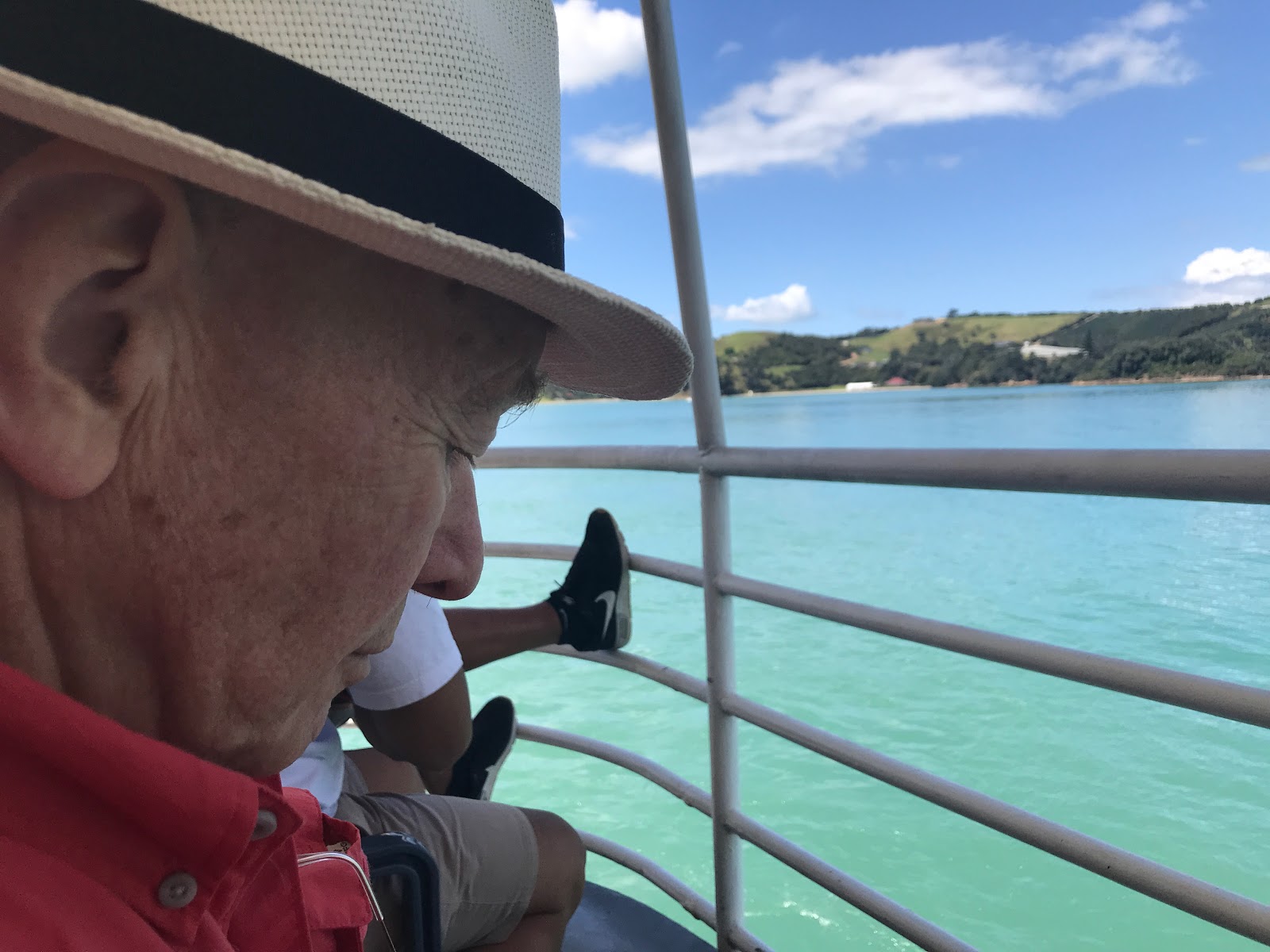
At Akaroa we boarded a catamaran for a cruise in the harbor and out into the Pacific to view spectacular sea caves, volcanic formations, high cliffs and bird nesting sites.  Some of the cliffs had evidence of lava flows that had cooled.  There were layers of evident volcanic ash, lava, ash, lava.  The water was green, green, the cliffs red, green, gray, silver.  We saw Hector’s Dolphins, one of the world’s rarest and smallest dolphins.  They are only about 4 feet long.  Today they were feeding and stayed just under the surface.  We also saw blue penguin and fur seals.  The day was warm and clear.  We’ve been most fortunate.  Pictures at flickr.

Friday, March 2, 2018

Kiwis and Christchurch

Taxidermist Kiwi

When we left Rotorua this morning, we first stopped at a Redwood Forest.  NZ attempted to grow redwoods for commercial purposes.  As it happened, the trees liked it so much and they grew so fast that the wood was too open and unfit for use.  The trees here were only about 50 years old and quite big.  

Next, we made a stop at Rainbow Springs, home to the National Kiwi Trust.  Since 1995 it ha been a nursery and hatchery for over 1350 kiwi eggs.  When sufficiently mature the chicks are released into the wild where the eggs were gathered.  We were allowed to watch behind glass as the chicks were weighed and measured.  They were about the size of a large pigeon and very feisty, kicking and squirming.  Our guide said they never imprint on the human and are easily released.  We viewed 3 adults that are permanent residents due to injury or handicaps.  They reverse night and day in the facility to allow for our viewing.  Surprisingly to me was how soft the feathers seemed.  The numbers are remaining stable UIKeyInputDownArrowbut not increasing mainly because of introduced predators like stoats, possum, rats, dogs, cats.  There were no mammals on New Zealand until the Maori came.

Parking Lots Dot Downtown Where Buildings Once Stood

This afternoon we flew to Christchurch for a 2 night stay.  On our coach ride to the hotel, our guide lectured on the earthquakes of 2010 and 2012 and pointed out the devastation and rebuilding still ongoing.  In my pictures you will see the large areas of vacant lots where houses have been cleared and no one is allowed to live there again.  Downtown is a jumble of parking lots where once stood buildings.  Huge cargo containers are stack one upon another to hold up buildings awaiting repair.  Christchurch was once known for its English Gothic architecture.  Now, most of that is gone. 70% of the central city buildings were destroyed and are now gone.  


Riccarton House

Tonight we went to Riccarton House for dinner.  Riccarton House is a significant early homestead.  Preserved there is a bush of native lowland polocarp forest.  The bush is securely enclosed with fine mesh fencing, electric wiring and traps.  We got a tour with explanation of the plants and birds.   Prior to dinner we had a tour of the house with a history of the family that settled there, the Deans (go Scots!).  After dinner we had a most delightful story teller.  Margaret Copland, in character, presented a biography of maternal great, great grandmother who came from England and her paternal great, great grandmother who came from Poland.  She was excellent.  Most of the pictures at flickr are not interesting except to document the devastation that still remains in Christchurch from the two earthquakes. But if you persevere to the end you will see videos of the life Kiwi.   Pictures at flickr

Thursday, March 1, 2018

Volcanoes, Mud Pools and Spears

Waitangi Volcanic Valley

Road Scholar is keeping us busy just about every minute.  Today we had three different site visits starting with the Waitangi Volcanic Valley.  Waitangi is the only major geothermal system in the world wholly created as the direct result of a volcanic eruption within historic times. Geologists come from all over the world to study the area and set up monitoring systems.  The exact day, July 10 1886, has been pinned down as the day the activity began.  That is the day of the Tarawera eruption when a crater was formed that encompassed two small lakes into one large Lake Rotomahana. The area sits in the Pacific “Ring of Fire” where the Pacific Tectonic Plate meets the India-Australian Tectonic Plate.  We began our site visit with a boat ride around Lake Rotomahana where we could observe the many steam vents and volcanic rock walls.  After, we hiked down into the Volcanic Valley where we could saw 3 other craters each consisting of different temperatures and minerals.  The colors of the deposits were beautiful, the earth was emitting heat, the water bubbling and spewing.  All plant and animal life here was obliterating in 1886.  Today the area is free of exotic and non native plants under the protection of its Scenic Reserve Status.  It looked like Jurassic Park to us with the 60’ ferns.


Arts and Crafts Institute

After lunch beside Rotorua’s Government Gardens where bocce courts were active and impatients grew 3 feet high, we went to the Maori Arts and Crafts Institute.  The Institute is set in another
thermal area with boiling mud pools and the spectacular Pohutu geyser which erupts up to 90 feet.  We missed that phenomenon, but did get a bit of a burp.  The goal of the Institute is to encourage and train young Moira in the traditional Maori arts and crafts.  We walked through the Institute and observed wood and stone carving, and weaving using both modern and traditional tools.

Maori Culture Performance

This evening we had a traditional Hangi dinner and Maori cultural performance and war dance.  This was similar to our dinner and performance at the Waitangi Treaty Grounds.  We both thought the Waitangi performance far superior.  I’m guessing that is because this Maori Village uses its extended family to perform rather than seeking out the best and professional performers.  At our dinner were about 100 people from all over the Northern Hemisphere: Poland, Egypt, France, Norway, England, Canada, Korea, Luxembourg and more.  Our host asked where people were from and then greeted and joked with them in their native language.  He was amazing and very funny.  As a note, the Maori Villages we visit are much like a tribe made up of extended family.  For example, there are 3000 family members of the Te Puia tribe that operate the Arts and Crafts Institute.  They all make a point of thanking us for our interest in the culture and how tourism has allowed them to save and revive their culture. Pictures at flickr.

Wednesday, February 28, 2018

Glow Little Glow Worm, Glimmer Glimmer

We left Auckland today and began our journey south.  We traveled through rolling green countryside populated with cows and sheep.  NZ is making more money from the exportation of milk and butter fat than anything else.  It was evident how low the population density is here.  On occasion were volcanic formations, thick bush and ostrich.

Outside the Glowworm Caves

Our first stop was in Waitomo where the glowworm caves are.  Our entrance was delayed by 30 minutes because the CO2 level was too high.  These worms are well protected.  The glowworm is unique to New Zealand.  The caves were discovered by two men and now belong to a Maori family of some 3000 descendants who benefit from the operation.  The caves are limestone and, thus, white as snow stalagtites, stalagmites and walls make up the cavern.  At the base of the cave we boarded a boat for a brief water exit. Quiet was the rule while we viewed the glowing little critters, heard the drip, drip, drip echo of the water and marveled at the glowworms’ reflections in the river. The glowing that one sees is from the maggot stage of a fly.  The glow is to attract river insects that the glowworm eats.  In a light the guide shown, we could see the thousands of clear filament strands that hangs from each worm and traps dinner.  The glow is a bright blue bioluminescence against the blackness of the ceilings.  When the glowworm becomes a fly flowing the cocoon stage, it only lives for about 5 days because it has no way to eat.  It starves to death.  But, there is a lot of sex going on to produce the next generation of glowing worms.  So never fear, there will always be light in the tunnel. No photos are allowed, though.  So you must go to see YouTube.

Volcanic Boulders Waikato

Rotorua, our final destination, is nicknamed Sulphur City.  Here is the most thermal activity in the country including hot springs, geysers and bubbling mud pools.  As we drove through the town there were 8’ pipes in private yards spewing steam.  As we exited our bus, we acknowledged  that Sulphur City is indeed a proper nickname.  More on all that steam tomorrow. Photos of the day at flickr.

Tuesday, February 27, 2018

Earth, Wind and Fire (also water)


Our lecturer today was one Dr. John Walsby, a spry little leprechaun who could not stop talking or leaping around for the entire day.  He is quite the Renaissance man: a marine biologist, natural historian, writer, illustrator and educator.  Gesticulating, joking, slinging chalk around, he lectured us on the geology of Auckland and the local coastlines.  After morning tea (yes, we have daily morning tea) we headed out with John for a first hand look at the geology he had lectured on.  It was fascinating to see the physical evidence of the volcanic and earthquake activity.  From tree fossils encased in lava on the coast to fossilized sea life we got a grand understanding of New Zealand’s formation.  He pointed out varied plant life, we stopped at caldera Lake Pupuka where black swan competed with wind surfers.  The wind surfers won my vote when they stripped out of their wet suits next to our bus.  We climbed North Head (another volcano) to see fortifications centered around massive guns installed to protect Auckland Harbor during WWII when American ships stationed there.

Dinner was on our own tonight.  Wayne and I went to the cinema to see Black Panther.  People in our group couldn’t stop raving about it.  One woman had seen it twice.  Hey, we thought, his is not to be missed.  We bought tickets at the Gold Class theater where one can be served dinner and drinks and lounge in a recliner.  The recliners were fabulous.  There is seating for 30 people with not a bad seat in the theater.  The servers are very quiet as they check on your needs.  I tell you all this because that was the best part of the movie.  Wayne and I think there is something wrong with our expectations because we found the movie boring.  We’re afraid to tell anyone else in the group.  We’re still wondering, what are we missing. Pictures at flickr

Monday, February 26, 2018

Sails, Gardens and Museums

All the Road Scholar tours include lectures by local experts on specifics about the local area.  We began with our series of lectures today when Gordon McLauchlan presented an introduction to New Zealand history.  He is a well know local author and journalist.  He gave us a good accounting of the Maori settlement of New Zealand, the coming of the Europeans, the war and treaty times between the British and the Maori, and current times.
Auckland Harbor Sail

Following the lecture we walked to the Viaduct Basin for a sail in the Waitematā Harbor.  The winds were up; the sun was out; the sail was perfect as we sliced through the channel, under the Auckland Bridge and around the volcanic cones.  I haven’t been sailing in years.  It brought back memories of great times sailing with friends to Cuttyhunk.
My Eden Gardens

After the sail our busy day continued with a motor coach ride to Eden Garden which was created in an abandoned quarry at the base of Mt Eden 45 years ago by a group of volunteers. The quarry was dug into Mt. Eden which was a volcanic mountain.  There are 50 volcanic cones in Auckland. The garden had a Jurassic feel with its impressive 40’ ferns as well as a variety of bromeliads.
Rangitoto Island from the War Memorial

Not to let us get bored or find time to complain, we were immediately bussed off to the Auckland War Memorial Museum.  The best part of this museum is that it was not completely about War.  A good part held a large collection artifacts from the Maori and Pacific Islands.  There was an entire carved meeting house built in 1878. The carving ability of the Maori using only stones is most impressive.  Some of the totem-like pieces date back to the early 1300s.  Lots of water pictures at flickr.


Sunday, February 25, 2018

Auckland Redux

Tour Leader, Heather and Site Coordinator, Albert, in his Park

There is not too much to report on today.  It was a slow and lazy day.  We believe the Road Scholar leaders are easing into touring to allow the others in our group to recuperate from jet lag.  Late morning we had an orientation meeting to go over logistics and introduce ourselves.  One couple has been on 30 RS trips.  There are photographers among us. Everyone is retired and  around our age.  There are 2 single women but all others are married, white Anglo and heterosexual.  (As far as we know).  There are 24 of us plus our site coordinator, Albert, and the tour leader, Heather. Of the 10 or so people we have spent time with, they are all interesting conversationalists, very well traveled, progressive and have an open dislike of Trump.  At last night’s dinner I did get trapped with one woman who talked about her grandchildren extensively.  This morning when she introduced herself she started on the grandchildren and a majority of the group yelled, “No grandchildren!”  I like them!  

Most of the Group

This afternoon Albert took us around central Auckland.  Much of it was areas we had been in.  But he added to that by pointing out significant buildings, the architectural style and period, and the current use.  

Auckland Harbor from the Grand Mercure Dining Room

Yes, people.  That is a cargo ship sitting in Auckland Harbor.

The group in front of the Auckland Museum.

Saturday, February 24, 2018

Handing Over the Keys

We had a leisurely leaving of Waiheke today.  Went down to Oneroa to buy a hat because I left mine behind at one of the vineyards yesterday.  I am not Scala hat worthy.  I have left one in Greece and now one in New Zealand (stay tuned for the sequel).  We bought a hat, had a gelato and then Wayne insisted we go to the vineyard where I left my hat, Peacock Sky.  Lo and behold, after some consultation with numerous people my hat appeared.  Now I have 2.  Are two hats better than one?

Eating Gelato in Oneroa

Upon arriving in Auckland, we dropped our Avis car and Ubered to the Grand Mercury Hotel which is a block up from the Princess Wharf and Auckland Harbor.  This evening we met up with our Road Scholar tour group. I will hold off on descriptions, critiques, and overall New England snobbish comments until a few days of breaking bread together have passed.  But, I’m hoping for some entertaining stories to emerge.  Stay tuned.

Ferry from Waiheke to Half Moon Bay

Friday, February 23, 2018

Ananda Artisan Wine Tour

Our Ananda Tour Group at Lunch

We took the Ananda Artisan Wine Tour today to four vineyards.  The first, Peacock Sky, was the best experience. There each tasting was paired with a food to compliment the wine.  This is a ‘degustation' experience in the French tradition. Our hostess was from Manhattan and on her way to becoming a world class product representative.  She was very good at explaining the effect each food had on the taste of the wine and why.  We had lunch at our next stop, Stonyridge.  The tasting was fast and straight forward without food.  The platter style lunch came after and was nice.  Our group was fun and all interested in learning more about the production of wine.  A young couple had just moved from Scotland.  She was born in New Zealand and had spent the last 9 years in Scotland with her bonnie beau.  I could not understand a word he said.  Wayne often quotes Churchill, “two peoples separated by a common language”.  The second couple was from Georgia but living in England.  I could understand both of them.  

Tantulus Vineyard

Our third stop at Tantulus was the most glamorous. The chandeliers were made from the vineyard’s old vines.  The new Canadian owners began with a different and more suitable grape variety, but gave a nod to the old.  The fourth and final stop was at Mudbrick, a vineyard we had visited.  The personnel at all the vineyards are frequently French.  Whether to add to the ambiance or simply a coincidence, I don’t know.  The wine industry is just a baby here.  The oldest vineyard was established in 1978. Way too many sunset pictures are at Flickr.

Thursday, February 22, 2018

Vineyard Hopping

No hot water today: cold showers and cold breakfast.  Just partially kidding.  The shower went cold toward the end but while the soap was still covering the bod.  Alice, our cottage manager, responded promptly by coming over and switching the propane tanks.  They don’t have hot water tanks to store the heated water.  It’s directly heated from the propane.  Since we had to switch houses once and then have a cold shower, she compensated with a late check out on Saturday.


We struck out on our own today for bites at several vineyards not on our Friday tour.  At Alice’s suggestion we started at To Motu (think tomato) where we had an octopus small plate.  I had rose and Wayne had a Cabernet blend. Neither of us had the To Motu wines as a glass started at $45.  We had Dunleavy which started at $12.  And, as Wayne likes to say, “That’s New Zealand dollars!”.

Passage Rock Wine Glass Vine Sculpture

 Next stop was Passage Rock where we had pizza.  I had rose; Wayne had water.  The most interesting here were the sculptures formed from grape vines.  Also, they left some vine rows uncovered where we tasted the grape directly from the vine. Then, with no GPS service we worked our way to Man O’ War which sits on Man O’ War Bay.  This was the best of all. Not for the vineyard which we actually skipped, but for the drive past about 9 bays that just take your breath away.  My photos will not do justice to the blue and turquoise of the water, the vastness and depth of the space, or the land masses and islands. Nor will you see Wayne’s white knuckles as he drove through traveled, one lane, twisting roads.

With this drive today we have pretty much circumvented the Island and, along with Condé Nast rate it among the world’s top 20 islands.  See pictures of it at flickr.

Wednesday, February 21, 2018

A Day of Art and Wine

View from Matahaipo Bach
We moved today to the cottage we had originally rented.  It is down Island a bit but still close to where the action is.  It is also in need of paint and yard work.  The bed has a significant slant to the east.  Only the view is top notch.  But it is clean; the kitchen is functional; washer and dryer are on site; the internet is sort of fast.

This whole island has a bohemian vibe that reminds me of Key West or the Caribbean.  For example, today we looked for art galleries and artists.  I was particularly interested in one of the artists who works in kauri. Walking steeply down the drive to his studio, we passed huge caches of kauri, several small dwellings and work spaces.  At the bottom of the steep, twisting, overgrown drive was a cottage with one side completely open to a patio.  On the patio were three 20 somethings just chilling out.  “Hi Ya. No we’re not the owner. He’s at the other studio.  He just comes and goes. Have a g’day.”  
Drive Way to Kauri Studio
UIKEYINPUTDOWNARROW

Drive Way to Kauri Studio
We next went to the Mudbrick Vineyard and Restaurant.  It is a gorgeous estate with manicured gardens of lavender hedges...HEDGES and topiary olive trees.  We had a small tasting of a Pinot Gris, Sauvignon Blanc, Syrah and Cabernet/Merlot blend.  They grow Bordeaux grape varietals but also use other grapes for some pressings.  From what I can determine, none of the vineyards process the grapes into wine.  They seem to use a vintner at a mysterious location “where they work closely with the vintner to achieve the quality wine you are now tasting”.  We are taking a wine tour Friday, and I will get to the bottom of this. Pictures of the gorgeous Mudbrick at flickr.

Tuesday, February 20, 2018

Cyclone Surfs

Onetangi Beach
We spent the day exploring and getting a feel for the Island.  The heaviest populated area is in the northern part of the Island where a small town sits.  There are dozens of art galleries we will check out later.  We drove on through that town into the more rural areas where the vineyards are.  Some of them seem to be on almost vertical tracks of land.  Because of the hilly terrain there are very scenic and expansive views of all the several bays, the Tasman Sea and the Gulf.  Cyclone Gita has been causing havoc north of here near Australia.  The southern Alps have slowed it to heavy winds.  We got a taste of it at Onetangi Beach.  See the pictures at flickr.

Monday, February 19, 2018

Island Living in Waiheke

Waiheke view from the Wine Loft
A good part of today was spent driving from Whangarei to Auckland and then taking a car ferry to Waiheke.  Waiheke is the second-largest island in the gulf with about 9000 permanent residents.  Like Wareham there are also summer homes for an additional 3500 visitors.  It is very hilly with only a few flat areas.  The narrowest point is only 2000’ wide.  The beaches are many and scenic.  


The Winemakers Loft

There was a bit of a mix up with our rental when they double booked our first day. As a result we are in another “Bach” for 2 days.  (Bach is the local term for a small rental).  We’re okay with it.  It sits high up in the middle of vineyards and sheep pastures with an overlook of Hauraki Gulf and Auckland in the distance.  We are in Waiheke for 5 days with plans to use the Hop On/Hop Off bus to visit the vineyards for which Waiheke is notable. Pictures of our day at flickr.

Sunday, February 18, 2018

Whangarei Waterfall and a Coastal Look See

Whangarei Water Fall

Even though we are staying in a Hotel.com lodge, it is much like a B and B with a made to order breakfast.  They even have individual French press coffee, our favorite.  Andy, the owner with wife Karen, was the chef.  I’m not sure if they live in the house.  The kitchen and dining room are in a building adjacent to the house.  There is another building across from the kitchen is that I believe has rooms.  The grounds are huge with orchards, stone walls and hedges that go to the clouds.  They have sheep, chickens, cattle and an ancient goat.  Andy gave us suggestions for the day.  We took his advise to start at Whangarei Water Falls.  These Falls are much more impressive than Rainbow and Hururu in Russell.  First, they are white, not brown.  But they have nice swimming holes at the top and bottom where locals were spending time.

Sandy Bay

From the Falls we drove up along the east coast to Matapouri and the Sandy Bay.  Here we had our first glimpse of real surf and surfers.  Along the way we passed through other small waterfront settlements with fishermen, sailors, and fun seekers.  Every harbor seems packed with sail boats.  The terrain here is fairly hilly with great vistas.  Quickly one can be looking at vast pastures and then suddenly be in deep woods.  

The Tidal Basin

This evening we went downtown to an area called The Tidal Basin which is where we had dinner the first evening.  Many sailboats are anchored there with people having dinner onboard.  Interestingly, most of them have photovoltaic panels mounted on them.
Pictures at flickr.

Saturday, February 17, 2018

A Long Day of Leaving and A New Day of Discoveries


Other than a brief sortie into town to walk along the docks, we spent the last day in Paihia sitting in the apartment and watching the ever changing sky and water.  There was for me an unusual pattern in the water as the tides moved.  A flotsam of sorts creates long white lines moving across the blue water.  The final night’s sunset was particularly beautiful.

Kauri Tree

Our next stay is in a harbor town back south toward Auckland.  Rather than heading directly south to Whangarei, we traversed the Island to the west in order to see the Kauri tree.  It is the largest tree in girth in New Zealand growing up to 165 feet high and as large in diameter as the Sequoia. The difference being the kauri maintain that girth to the canopy.  Our search was for ‘Te Matua Ngahere’ the 2000 year old giant in the Waipoua Forest. We found our tree and were appropriately awestruck.  Also in this forest are ferns so large we thought them to be palms.  The drive in and out of the forest was steep and hairy with constant triple cutbacks.  And, don’t forget we are on the WRONG side of the road.

 It is the kauri that was used to make the Long Boat seen at Waitangi.  They were also desired by American and European ship builders for masts.  By the 1900s less than 10% of the original kauri survived.  Today less than 4% of uncut forest remain.  I had known of this tree when reading Barkskins by Annie Proulx.  This book follows the settling and cutting of Canadian forests by the French.  At one point these and British logging companies went to New Zealand and began cutting the Kauri.  It’s a very interesting and well written book.

We drove into town tonight and went to the harbor area for dinner.  There were dozens and dozens of people around all dressed in white.  We thought we were at a Kardashian wedding.  Turns out to be some big annual social even on the water front called the White Plate Dinner.  We went straight for the multicolored venison dinner plate.  A lot of really repetitive pictures of the landscape are at flickr.

We arrived late afternoon in Whangarei where we are staying outside of town in a lovely old home with 15 foot ceilings, orchards and a swimming pool.  We are here for 2 nights.  Pictures at flickr.

Thursday, February 15, 2018

Waitangi and the Maori


The Maori were a fierce people and it shows in the performances we saw today.  We spent most of the day at the Waitangi Treaty Grounds which abut Paihia where we are staying. They are beautiful grounds with deep forests and vegetation as well as a fine overlook of the Bay. The early afternoon we took a tour that introduced us to a bit of history.  The Maori discovered and eventually settled in the Bay of Islands some 700 years ago.  Assuredly they came from Polynesia but perhaps even earlier from Taiwan.  At some point they developed a warrior culture which was, of course, predominantly male dominant.  When Captain Cook came in 1769 and later in the 18 century the whalers, relations were amicable. But by 1840 the British pretty much controlled things and coerced a treaty that to this day is contentious.  There was an English treaty and a translated Maori treaty that was interpreted differently.  Unclear to the Maori were trade and land sale restrictions that led to social upheaval and war.   By the beginning of the 20th century the Maori began to recover from decades of conflict and disease.  Today they are the sole proprietors of Waitangi.  It was a moving experience to watch the performances and hear them speak.  We were not allowed video in the meeting house where 4 women and 4 men performed dance, sang and played games.
The Hangi Pit
That evening we enjoyed another performance and a Hangi dinner.  Hangi is a traditional New Zealand method of cooking food in a pit over with lava rock.  The demonstration and revealing of our meal in the pit reminded me of the New England tradition of a clam bake.  We dined outside and chatted up with a couple from Australia who gave us tips on Sydney. 

PS  Many of the whalers who landed in Russell were from Nantucket. See pictures and video at flickr.

Tuesday, February 13, 2018

Ferry ‘cross the Waikari

Our Digs from the Beach and the Beach from Our Digs

We left Russell yesterday for Piahia, which is only across the Pamare Bay.  One can see Russell from here.  The advantage to staying here a few days is much easier access to sites in the Northland.  Our apartment is perched, and I mean perched upon a cliff directly up from the Bay.  We had a heart stopping experience getting here.  The GPS first lead us down a vertical road with 180 degree turns.  We got to a point where I was out of the car looking to see if the road continued.  And, it did but the next turn was impossible to make.  So, making a 12 point turn and back to the top of the road, I trekked to a nearby house, yelled from the front yard so as not to frighten the owners, and got better directions.  It turns out the GPS was taking us to the owner’s house, and that final turn was a foot path to the beach.  Memories of Sicily where the GPS took us to a staircase.

The apartment is beautifully appointed with grand views.  We could actually walk the beach to town which is around the point seen in the photo above. Town is not as quaint as Russell but has more restaurants, hotels, and shops.  It appears to be more of a vacation destination than a place with summer homes like Russell.

Today we explored the area by going to two waterfalls.  Because of all the recent rains they are full and roaring.  But once you’ve seen Niagara Falls everything else falls short (sorry).  I took a walk on the beach which as unusual to me oddly colored cliffs and boulders massed with oysters.

Tonight we had a Valentine’s dinner at Provenir.  It was pre fixe beginning at 7pm and ending at 10pm.  There were 7 courses, all elegantly presented and paired with a wine.  From oyster saviche and fried grouper to lamb and chocolate mouse, we stuffed ourselves.
Pictures at flickr.

Monday, February 12, 2018

Hole in the Rock

Bay of Islands, New Zealand
The weather broke on our last full day in Russell to provide us the opportunity to take a beautiful tour through the islands.  The highlight was a visit to The Hole in the Rock.  The more romantic description would be the Maori name of Motu Kokako. For the Maori it is historically associated with a range of sacred activities. According to Wikipedia it is probably the most important island in the Bay in conservation terms being in near pristine condition.  But most importantly for our tour guide was motoring through that hole for which the island gains its commercial name.  Personally, I was a bit skeptical. But make it through we did.  Along the way to the Hole we were escorted by a pod of bottle nosed dolphins including a new born.  Heading back to Russell we stopped at one of the more developed islands for a less than memorable lunch.  But, it did give us the time to finally put our toes in the South Pacific.  (Now I can’t stop singing “I’m Gonna Wash That Girl Right Outta My Hair”).

Upon returning we visited with John and Janette, the owners of our rental.  They live above us in the terraced home, and have a fantastic yard and view of the harbor.  John treated us to grilled mussels (yes, those giant ones) and rose wine.  John and Janette are originally from Liverpool but live here 6 months of the year and Australia 6 months.  Sitting on their deck we saw a Kiwi.  No, not really.  That is a joke.  It was a Weka.  But Janette said she let’s other visitors believe they are seeing a Kiwi just to make them happy.  We, knew the Weka from our trip to Flagstaff Hill.
You can see long videos and pictures at flickr.

Sunday, February 11, 2018

Omata Estate Vineyard

Wayne at Omata Estate Vineyard

It was another very rainy and cloudy day.  But we put on our galoshes and drove out to the Omata Estate Vineyard.  As we took off, the rain broke and Wayne braved the narrow, winding and very steep drive on the “wrong side of the road”. The vineyard describes themselves as a boutique vineyard.  The Omata kitchen offers a lunch and a tasting.  The wood-fired pizza we had was excellent.  The tasting consisted of 5 varietals of wines: Chardonnay, Pinot Gris, Shiraz, Port, and a rose.  I had thought the tasting included a tour, but the wine is not processed on site.  

The Duke of Marlboro Restaurant

This evening we dined at The Duke of Marlboro Hotel and Restaurant.  The facility sits on the first piece of land sold to a European, an ex convict. The hotel began in 1827 as an unlicensed grog shop.  Today the much expanded Duke has been refurbished and offers nice dining.  


Our day ended with a glimpse of the sun as it set beneath the clouds. See more photos of the vineyard and Marlboro at flickr.

Saturday, February 10, 2018

Getting to Know Russell

Russell from Flagstaff Hill Historic Reserve
The walk from our apartment to the village center is about 5 minutes.  We took that walk back to the Gables for lunch.  We had the same rather unfriendly waiter.  I thought that was just his unlikable personality until a table of young, attractive women came in.  He couldn’t smile enough, joke enough or pay enough attention to them.  Despite him it was a lovely lunch of mussels.  The biggest, fattest mussels I have ever had.
Mussels in Context
After lunch we took the Russell bus tour.  Our driver pointed out historic buildings in the village, gave us a bit of history, and then took us up to Flagstaff Hill Historic Reserve.  There are two paths, one of which leads to the famous flag pole on Flagstaff Hill. The Maori, Hōne Heke and his cohorts, cut the first four flagstaffs down in objection to British sovereignty which they believed was not honoring the Treaty by placing restrictions on trade and land acquisitions.  All of this resulted in the Northland wars and the sacking of Russell in 1845. Today the flagstaff stands and the New Zealand flag flies.
Sundial at Flagstaff 
The other opposite path leads up to the lower summit of the hill and sports a large sundial with a mosaic base. The views are almost a 360 degree view of the Pacific and the Bay. 
Photos of the day are at flickr.