Friday, February 14, 2020

The Mysterious Etruscans

Sarcophagus of the Spouses
I love the Etruscans for many reasons, but particularly because of the gender equality in their society.  Women engaged and participated in Etruscan life equally with the men,  Unlike the Greeks and Romans of this period who would not allow the women to even eat with them, the Etruscans reveled in partnership with each other,  This sarcophagus is a strong example of that. It represents the husband and wife of equal proportions attending a banquet, reclining on a kline (dining couch).  Very little is known about the Etruscans as none of their own literature or histories survive.  The buildings were made mostly of wood and, thus, have been lost.  What did remain are the extensive necropolises built to replicate Etruscan rooms and filled with artifacts and replicas of their daily lives.  The National Etruscan Museum has room after room of the excavated artifacts from the necropolises.  Etruscans traded with the Greeks whose beautiful vases can be seen here along side the Etruscan terra cotta and bronze pieces.  

Today's walk took us to the Piazza Popolo again and then through the north portal onto the Via Flaminia, once the ancient road to the Adriatic Sea. Along the way we saw a few minor fountains.  See all this at Flickr

Observations from two visitors.
   No matter your age, females can opt for bright red or orange hair.
   Great lunches can be found in the most unexpected places.  

Fountains
   Fontana delle Conche
   2 Nameless
  

Thursday, February 13, 2020

The Roman Forum

The Roman Forum
We let the professionals take over today.  Talk Walks Tours was recommended by Rick Steves, and turned out to be a good decision.  The tours are small (10 people today) and allows one to skip all the long entry lines.  Our guide, Elena, was very well informed and pointed out history and structural aspects we would have probably missed.  The tour included the Colosseum (upper and lower levels), the Palatine Hill and a look at the Roman Forum.  We got a complete description of how the Colosseum was constructed, the original appearance and the functions.  Elena continued to impress upon us that this was a place of death. Events were sponsored by the wealthy and powerful in order to appease the middle classes and the poor, "Bread and Circus".  Sound familiar? Over the nearly 400 years of use, it is estimated that 400,000 people and about 1,000,000 animals died here.  During Titus inaugural 100 days alone more than 2000 gladiators died.  And, the people loved this.  Wow!

The steep climb up the Palatine Hill was well worth the effort.  Here, where Romulus founded Rome, are the remains of the wealthy rulers' villas and the Gardens of Farnese.  The Hill offers an expansive view of the Forum and the surrounding area and is where Elena pointed out significant buildings.  She left us here, and we walked down into the Forum area for a leisurely walk and viewing.  We were impressed with the Temple of the Vestal Virgins and Caesar's cremation site.  Surprisingly, the Forum is a very small area amongst all the larger ruins of temples and shops of the area.  Our exit took us under the Via dei Fori Imperiali and into Trajan's Forum.

At Elena's suggestion we had a late lunch at Ai Bozzi in Trastavere.  The outside belied an elegant interior where we had delicious beef carpaccio and polio.  Pictures worthy of a travel log at flickr.  

Observations of two visitors.
   The Roman Forum is really just a tiny rectangular area amongst all the ruins.


Wednesday, February 12, 2020

An Angel's Eye View

Atop Castel Sant'Angelo
Here we are atop what was once the tallest building in Rome, Castel Sant'Angelo.  In the background you can see all along the right bank of the Tiber with St Peter's Basilica dominating the skyline.  Initially, Hadrian (he of the wall) commissioned this as a mausoleum for himself and his family.  And, indeed his ashes were here until the Visigoths played havoc with the place.  But time passed, the Popes took it over and converted it into a castle in order to protect themselves from invaders. They built a covered fortified passage from the Castle to the Vatican.  If you're familiar with Dan Brown's Angels and Demons, you will recognize this passage as playing a key role.  There is a beautiful bridge built by Hadrian and now adorned with marble angels that leads to the Castle.  Finally, the structure was used as a prison where some pretty famous people resided, Benvenuto Cellini among them.  Today it is a museum empty of most contents. 

Earlier in the day we toured the art gallery of the Palazzo Corsini which holds mainly Italian art from the early Renaissance to the late 18th century.  It's small but associated with the Palazzo Barberini Gallery which we will visit later.  
Beautiful views at flickr.

Observations of two visitors.
   Winter in Rome is like spring in Massachusetts
   Street Sweepers will always win the automobile right of way.
   Jazz musicians playing on the Ponte Sisto are icing on the cake.


Tuesday, February 11, 2020

A Good Walk Ending in a Good Aperitivo

Via Luciano Manara
Today we explored our neighbor and surrounding areas in Trastevere.  Trastevere literally means beyond the Tiber.  The earliest settlement here was the Etruscans while regal Rome was across the Tiber. By the time of the Republic, Trastevere had become part of Rome.  It was a center for a Jewish community and fishermen.  During the Imperial period the prominent Romans began to move here and build villas.  Gentrification has been around a long time.  Today Trastevere continues to maintain its character of narrow winding cobblestoned streets lined by ancient houses.  It's fun and challenging to share these narrow ways with automobiles.  Pedestrians really do rule here.  Graffiti is everywhere, but once accustomed to it, it seems to belong.  It has some of the best restaurants in Rome.  At night the people gather in the piazzas to drink, laugh and listen to music all in a friendly, safe environment.

Our walk took us pass two American universities, John Cabot and The American University, which helps explain the many English speaking young Americans we see here.  We walked further on along the Tiber to find the Palazzo Corsini, one of the late Baroque Villas built here.  We will return tomorrow to check out the art collection.

Poet Trilussa Monument
On our way back we discovered a monument to the poet Trilussa, an anagram of his surname, Carlo Alberto Salustri.  He was quite the character preferring to hang out in the streets and taverns rather than with the literary circles  He has his own piazza and fountain at the foot of the Sisto Bridge. 

Aperol Spritz at Grazie and Graziella
We ended our night with aperitivo, better know to us as happy hour.  It begins around 6pm and is meant to enhance your appetite with light fare accompanying the drinks, and prepare you for the 9pm dinner.  Needless to say we had our aperitif but also calamari and pizza which we called dinner.  I had the traditional Aperol Spritz which is concocted from Aperol, Prosecco, club soda and slices of fresh orange.  The Aperol gives the drink bitter notes.  

A further look at Trastevere at Flickr.

Observations of two visitors.
    There are a lot of beggars at the popular spots, some very aggressive, 
     
Fountains
    Fontana dell'Acqua Paola in Piazza Trilussa, aka Fontana di Ponte Sisto 

Monday, February 10, 2020

Dying Gauls and Fried Artichokes

In the Nave of the Basilica di Santa Maria Maggiore
We returned to the Campidoglio today to visit the museums.  It was a cloudy, misty day and perfect for indoor activity.  The line was very short and the galleries practically empty.  February really is a good month to avoid the crowds.  The two museums are connected by an underground passage that holds many artifacts. We used the passage to visit both buildings. There are a few paintings here, but mostly sculptures from antiquity.  In fact, many sculptures are called The Capitoline ....." as in The Capitoline She-Wolf.
The Capitoline She-Wolf
My favorites were The Dying Gaul and Venus.  Also liked for the sheer magnitude was a very empty large room completely covered in frescos.  It seemed a life time's work.  

Next door to the Campidiglio is the Basilica Santa Maria Ara Coeli where we saw the tomb of Cecchino dei Bracci, Michelangelo's lover.  Michelangelo designed the tomb and wrote love poems to Bracci.  Some 20 years ago when we were here our plan was to attend Christmas Eve midnight Mass in this church.  Like the best laid plans, we failed to keep that date.  So, it was nice to be there at last.  Also here is the Santo Bambino, a wooden carving of a standing baby Jesus said to be miraculous.  He is associated with healing the sick, particularly children who write thank you notes that surround the icon.  I walked around the church twice and never found the little bambino.  
Courtesy Wikipedia
Thinking it was not too far, we headed off to the Basilica of Santa Maria Maggiore. 30 minutes and 2 major hills later we found her.  And she is major indeed!  It is truly Roman in design without a hint of the Baroque. This church displays 5th century mosaics in wonderful condition.  The arch and the nave have some of the oldest representations of Mary in Christian antiquity. St Jerome is buried here in a crypt beneath the high altar.  

We had dinner tonight at Nonna Betta's, recommended in many guides we've consulted.  They are praised for the Jewish artichoke.  Artichokes are in season now, and this was our 3rd try. The critics were correct; they are the best.  Nonna Betta's is a kosher restaurant located in the Jewish quarter.  In the quarter are cobblestones capped in bronze and installed outside the last residence of victims of the Holocaust. Each plaque is detailed with the victim's first/last name, birth date, date and place of deportation, and date of death in a Nazi extermination camp.
See our day at Flickr 

Observations of two visitors
    Speeding cars and motorcycles really will stop if you are in a crosswalk.  

Churches
    Basilica di Santa Maria in Ara Coeli al Campidoglio 
    Basilica di Santa Maria Maggiore


Sunday, February 9, 2020

Greeks, French and the Spaniards, Too.

At the Bottom of the Spanish Steps
When we were in Vienna a few years ago we sought out Cafe Hawelka, an old venerable coffee house where well-know writers and artists would meet.  We've also been to the Algonquin Hotel where Dorothy Parker regaled and Harry's Bar in Venice where Hemingway liked to hang and beef carpaccio was invented.  In keeping with travel tradition we decided to try the Antica Caffe Grecco, the oldest coffee house in Rome.  Past patrons have included Goethe, Keats, Ibsen HC Anderson and even Casanova. While the pastries were artistic phenomenons and the joint was packed with memorabilia (as well as tourists), it felt more like a contemporary atmosphere than a walk back in history.  We paid dearly for a tiny, tiny espresso. 

A short walk on found us at the foot of the Spanish Steps admiring the Fontana Barcaccia, a boat shaped fountain that sits lower that street level and was believed to be designed by Bernini's father.  This is to accommodate for the low water pressure from the aqueduct.  We old dudes walked all the way to the top and visited the French church Trinita dei Monti.  To give the French credit, they actually paid to have the steps built in order to link their church with the Spanish Embassy.  There is a new rule in Rome; thou shall not sit on the steps.  The polizia roam (lol) the steps blowing their whistles at anyone who sits.  It's quite funny.  To the amusement of the polizia, Wayne and I helped by pointing out offenders. 

Palazzo Zuccari
Near the Trinita dei Monti are two interesting buildings.  The Palazzo Zuccari pictured above which was built by the artist Zuccari, and the Palazzo Borghese, those same people of the gardens and gallery.  See more of these at Flickr.

Observations of Visitors
     The sidewalks are a battle field. The smart phones are winning.
     The shop window designs are works of art.

Churches
     Trinta dei Monti
Fountains
      Fountain of the Piazza Colonna
      Fontana Baraccia
      

Saturday, February 8, 2020

We the People

Wayne Admires the Piazza Popolo
The Piazza Popolo is one of the grandest squares in the world.  During the Empire period, it marked the entrance to Rome.  We entered through the Via del Corso and immediately came upon the Egyptian obelisk that stands in the center of the piazza.  It is the second oldest and one of the tallest in Rome with a fountain of Egyptian-style at the base.  There are 2 other large fountains present: The Neptune and the Goddess of Rome.  But most important for me, was the Santa Maria del Popolo church where two of the most significant paintings by Caravaggio hang.  In this church are two chapels, the Cerasi, which holds the two Caravaggios and the Chigi, which holds two Bernini sculptures. The Caravaggios are difficult to completely appreciate due to the positioning on side walls in the small chapel.  Plus, you have to pay to have them lit for viewing.  Legend has it that Nero was buried at this sight. A great walnut tree grew at the burial site from which demon wolves began to haunt and terrorize the population.  The Pope at the time cut the tree, exorcized the demons and built the church. The factual basis of the legend is weak.  No kidding! 


Earlier in the day we took a detour to the Via del Babuino to check out the Fountain Baboon (Babuino). It is another of the talking fountains where people post political complaints. It is quite small and covered with moss.  Simple and engaging.  

As we walked home over the pedestrian bridge, Sisto, musicians were playing and the sun was setting over the Tiber.  

Plenty more to see at Flickr

Observations from a visitor.
      1. Dogs go to the Supermarket
      2. Italians talk very loudly, and I often can't tell if they are in an argument.


Friday, February 7, 2020

Borghese and Bernini

Wayne in the Borghese Gardens

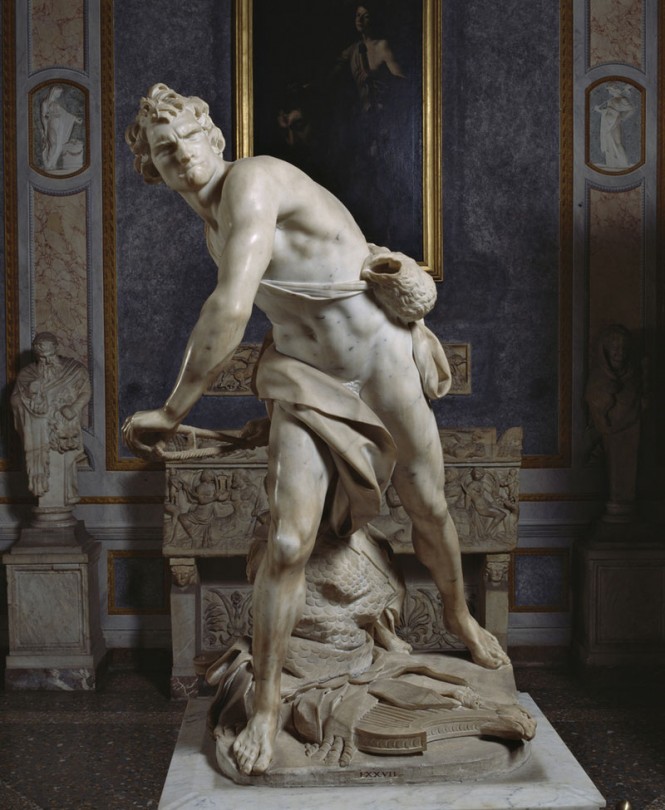
We dedicated our day to the Borghese Gallery and Gardens.  It was about an hour's walk up to the Pincio Hill where the Gardens sit overlooking the famous and popular Piazza Popolo.  We had a 1pm entrance time and were allowed 2 hours in the galleries. This was so much better than a simple entry time, which we had for the Blake in London.  Because there was not a mandated exit time at the Blake, it became so crowded one could hardly move.  Here, it was a wide-opened look at the most beautiful works.  Cardinal Scipione (Skippy from now on) was a major collector of art and sculpture, a patron of Bernini and an avid collector of Caravaggio.  This collection is beyond fabulous.  It contains three sculptures by Bernini that eclipse any other sculpture I've seen.  And, I've seen Michelangelo's David.  Bernini also completed a David who moves with the Baroque flourish of a man filled with rage.  The Rape of Proserpine, and Apollo and Daphne are marvels of workmanship. The negative, open spaces and delicate forms achieved in the stone mystify comprehension. There is also a quite nice sculpture of Napoleon's sister, Pauline, by Canova.  She is top-half naked reclining on a sofa. Asked during the posing if she was not uncomfortable posing that way, she replied, "No, it is quite warm with the stove."  No photos are allowed in the gallery so I have downloaded these for viewing pleasure.  
David

Apollo and Daphne


The Rape of Proserpini

Pauline Bonapart
No justice here with these photos, though.  One must examine great sculpture in the round. We ended the day with a walk through a small part of the extensive gardens and found Wayne a nice fountain.

Everywhere are churches, big and small.  We can't resist sticking our heads in all of them. Each and every one is a wonder to behold with unrestrained Baroque flourishes of marble, sculpture, paintings.  We found the Chiesa San Marcello al Corso on the walk home.  

Observations from a visitor:  Shoppers bring there dogs with them to the supermarket.  There are special carts with a space for the dogs to sit.  The dogs are actually better behaved than some American's I've encountered.  

 Pics at Flickr.


Thursday, February 6, 2020

Fountains, Bones, Montague's, Capulet's Oh My, Oh My

Fountain of the Naiads
We began our day climbing to the top of the Viminal Hill where the Fountain of the Naiadis sits in the center of Piazza della Repubblica.  This area is where the Roma Termini is located and is home to the prestigious Teatro dell'Opera which we attended this evening.  It is also where the Diocletian Baths were located. Our central objective was the Fountain of the Naiadi's. It is one of the largest monuments in Rome, with four naked sea nymphs each wrestling a water creature.  Initially, the provocative nature of the fountain was considered obscene resulting in the nymphs being draped.  Later Victor Emanuel's wife said, "this is rediculous".  She disrobed them, and the nymphs could again breathe freely. 

Across the Piazza is the Santa Maria deli Angelico's e dei Martiri (see! Another Mary church) built in the ruins of the Diocletian Baths. The facade is the wall of the frigidarium; the interior of the church is designed by Michelangelo following the form of the Greek cross.  The transept is so large with vast cubical insets at either end that it appears almost as a nave.  The overall affect for me was one of a cube.


Fountain of the Tritans

Leaving Viminal Hill and headed to Quirinal Hill we passed the Santa Maria della Vittoria, where the noted Teresa in Ecstasy sculpture by Bernini presides.  What can I add to my admiration of Bernini's ability to make stone sing?  The sculpture is lit by natural light coming from a hidden sky light.  The whole thing resonates with emotion.

Further on in Piazza Barberinni we searched out The Fountain of the Tritans. It was beautifully set off by a waxing gibbous moon. Again, a Bernini designed fountain. It is the first of his free standing fountains meant as a dramatic celebration of a reconstructed aguaduct.  

Practically next door is the Capuchin Crypt, a completely bazaar yet fascinating space of small chapels beneath the Santa Maria della Concezione dei Cappuccino (Ahem! Mary!) The chapels contain the skeletal remains of 3,700 Capuchin friars.  But that is not the interesting fact.  All the bones have been utilized to create decorative motifs.  No photos were allowed so one must link here to get the total effect.  Please note that every decorative aspect is a bone.  https://www.atlasobscura.com/places/santa-maria-della-concezione

After a so-so dinner at la Locanda dei Pugliesi we walked across the street for the opera, I Capuleti e I Montecchi, more familiar to us as The Capulets and The Montagues in   Shakespeare's Romeo and Juliet.  There was not a light, fun or joyful moment in this opera. At least Shakespeare let Romeo and Juliet have a night of ecstasy.  Belini's opera was one long sad event.  The singing was superb, though.  
Some pics at Flickr.

Fountains
 The Tritans in Barberini Piazza 
 The Naiads in Piazza Repubblica

Churches
 Mary of the Angles and Martyrs in Piazza Repubblica, Viminal Hill
 Mary of the Conception with the Cappuccino Chapel
 Santa Maria della Vittoria


Wednesday, February 5, 2020

The Pantheon

Inside the Pantheon
Our walk to the Pantheon led us through the Piazza della Minerva, which was a delightful discovery.  In the center of the piazza stands the Elephant and Obelisk, a sculpture by Bernini that sits at the base of the smallest obelisk in Rome.  A short distance on, we past the side of the Pantheon which offers the clearest view of the original foot or base of the church.  Around to the front at the Piazza della Rotunda we sat on the steps surrounding Pantheon Fountain listening to a podcast about the Pantheon.  Jane's Smart Art Guides are excellent for greater understanding of specific pieces of art.  We are sharing blue tooth ear buds which are advantageous for simultaneous listening and also avoid irritating any nearby persons.  

The interior of the Pantheon is beyond amazing.  The shear space and perfect geometric dimensions constructed 113-125 AD astounds me.  I can't even construct a decent frame with power tools.  Jane described in detail how the Pantheon was built, particularly explaining the use of materials in the dome's construction.  Inside, she led us around the perimeter to each chapel, my favorite being the tomb of Raphael.  

On the way home we sought out a small fountain, The Water Bearer.  The Visigoths destroyed the aqueducts during their 410 invasion, knowing the city could not survive without that water source.  Subsequently, water bearers would gather water from the Tiber and sell it throughout the city.  During the Renaissance the aqueducts were rebuilt to supply all the fabulous new fountains.  This put the water bearers out of business.   The fountain was created as a remembrance to these men.  It is one of the 'talking' statues of Rome wherein people would post anonymous political expressions.

Our attempt at a home cooked fettuccine carbonara was, well, not so good.  We shall try again, though.  Pics at Flickr.

Tuesday, February 4, 2020

Fontane e Carciofi

The Turtle Fountain

Yesterday may have been Church day, but today the fountain rules.  The Turtle Fountain is is the Jewish Ghetto just a short walk across the Tiber.  The Jewish population is Rome is likely the oldest in the world continuously existing since 161.  As it goes with Jews, things weren't always pleasant.  Conditions in the Ghetto beginning when Pope Paul IV walled off the area were horrendous. The area suffered flooding,  all rights were revoked and living conditions were appalling.  Today the area is home to the Rome Synagogue,  the Turtle Fountain, and the Portico d'Ottavia, which are ruins about 20' below street level.  It was here that we sought out Nonna Betta, the premier restaurant to have fried Jewish artichokes.  'tis the season for them.  However,  Nonna was closed and the place next door where we ate was not all that good.  Service and wine were as always, above average.  But the artichokes were over-cooked and oily.  

After lunch we headed to the Piazza Navona for a look at the fountains, particularly the Four Rivers.  This very notable and famous fountain was designed by Bernini, our favorite Baroque sculptor.  The day was beautiful with full sun and temps in the 60s.  We sat, contemplating and drawing.  While here we entered St Agnes Church (sorry no photos allowed).  Agnes was another virgin, beheaded for her purity and devotion to Christianity.  Poor thing was only 12, an age where one should stick to virginity.  


Dinner tonight was at Endo at 21.  This is a very popular place.  Last night we were in an outside line of about 40 or 50 people where seating allowed for 30 at the most.  We broke line and made reservations for this evening.  The tables are packed cheek to jowl in the tiny area.  We sat shoulder to shoulder with 5 more.  Fettuccine with sausage and ribs was a delight.  We also tried the fried artichoke again, this time with delicious results.  


Fountains and more are here.


Monday, February 3, 2020

Roaming in Rome's Trastevere

Santa Cecilia
We stuck to the Trastevere district today focusing on churches.  Boy, Mary is a very popular name for a church, adding to my confusion about which church is which and where it is.  The Piazza Santa Maria (see!) near our apartment is the home for Santa Maria in Trastevere, one of the oldest churches in Rome dating back to the 340s.  Most impressive were the mosaics and the coffered ceiling. Just a complete wow.   It retains its Romanesque structure. This is also where the oldest fountain flows that I mentioned 2 posts past. Rumor has it the night Jesus was born oil flowed from the ground where the fountain was built lighting lamps for eternity. Well, for eternity or until modern times when one could verify things with google.  

Our next stop was Santa Cecilia in Trastevere. St Cecilia is the patroness of musicians.  Appropriately, a beautiful organ piece welcomed us as we entered.  Playing the organ was one of the Benedictine Nuns who live in the adjacent monastery and have charge of the basilica.  Cecilia was born into a prominent Roman pagan family.  At some point she embraced Christianity, and took a vow of virginity.  In a nutshell, she got married, he converted and honored her virginity, she angered the pagans, they cut her head off. There is a lovely sculpture of her by Stephano Maderno under the alter.  He did an excellent job showing the cut in her neck.  

Our last church was Cheisa Santa Maria dell Orto (Mary? Again?). This interior was Baroque to the max.  Not one centimeter of surface was free of design.  This church was built in an area of Etruscan encampment. It is also the reference church for the Catholic Japanese community of Rome.  

Finding dinner tonight was an adventure.  We started out at a recommendation that from the obvious line outside would not suit our patience.  So, we made a reservation for the next night and headed off to find a nice touristy spot, which we did.  It was fine.  Really.  How can one go wrong with pasta and Rome.  See pics of the churches and the martyr Cecilia here


Sunday, February 2, 2020

One Hill at a Time

Roman Forum from Capitoline Hill
We had our first official Roman meal at da Vittorio a Trastevere of pappardelle, artichokes and sausage all in a cream/cheese sauce.  My mouth is watering again!!! It served us well as an energy source for our trek across the Tiber.  We walked across the Tiber Island (the only island in the Tiber in Rome) where once stood the temple of Aesculapius, the Greek god of medicine and healing.  Today there is still a hospital and basilica on the island. As it was a day of exploring for us, we had no specific plans. Crossing the Tiber we first  walked around and then to the top of the Capitoline Hill.  Here sits the Piazza del Campidoglio designed by Michelangelo.  As well as museums and statuary, the hill top gives one a beautiful view of the Forum.  I discovered an interesting fact about the Campidoglio design.  Pope Paul III commissioned Michelangelo to design the piazza, which was to be Rome's civic center, so that it faced away from Rome and toward Vatican City.  

Down the back side of the hill, we walked the length of the Forum toward the Colosseum.  The last time we were here we could view the entirety of the Colosseum down the length of the via dei Fori Imperiali.  Today, not so much.  Large, high and very ugly walls block access and advertise where to buy tickets.  We did walk down and then returned on the other side of the street to look into Trajan's Forum and his very impressive column.

The sunset was beautiful as we left Rome, crossed the Tiber and reentered Trastevere.  A little shopping for breakfast, and we were home again.  See evidenced of our day here.


Saturday, February 1, 2020

It's a Beautiful Night in the Neighborhood

Piazza Santa Maria
We spent most of today traveling.  It was a 2 hour Uber ride to Gatwick, which by some miracle the concierge noticed was our airport when I asked the best way to get to HEATHROW. OY! 

We were met by Mateo in Rome who greeted up politely and then never spoke another word on the drive in.  He did remind us of the Italian tendency to drive as if you are in the Daytona 500.  We are housed in Trastevere, which is on the same side of the Tiber as Vatican City.  It was a stronghold of the Etruscans until the Romans took it in order to control that side of the Tiber.  It was an important Jewish center until they were forced to move to the Roman ghetto on the other side of the Tiber.  Today, it remains a funky, bohemian-like area with narrow cobble stoned streets.  Our apartment is near the Piazza Santa Maria in an area filled with every type of specialty shop one could want.  The streets were brimming with people; the shop keepers were very helpful to two mono lingual people.  Our new Italian word: Enoteca or Wine Shop.  The clerk in the enoteca wanted to talk Celtics basketball.  We love it here.

The Piazza Santa Maria has what is considered the oldest fountain in Rome dating to the 8th century.  It has been moved and redesign several times with Bernini's design now in place.  This is a serendipity because Wayne has been studying about all the fountains and made a quest to visit them.  Additional media at Flickr.
The Fountain of Piazza Santa Maria

Friday, January 31, 2020

A Brexit Day in London Town

It was a day of sight seeing, art, more art, and music.  We began the day by walking the south bank of the River Thames, which is my favorite side.  One gets a clear view of Parliament from there.  Also, Shakespeare trod that shore often.  We took about an hour's walk up to the Millennium Bridge, a pedestrian bridge that offers a grand view of St. Paul's Cathedral as one crosses over.  From there we circled back another hour for our 1pm appointment at the Tate Britain to view the William Blake exhibit.  With our timed entry we expected the crowds to be controlled.  Perhaps they were, but the rooms were packed and one had to stand in a queue moving at a snail's pace to get close up views.  It was fun to see some pieces that we've only see in reproduction before.  Favorites were The Ghost of the Flea, Newton, and The Ancient of Days.  
The Ancient of Days
The Ghost of a Flea


Newton


Early evening we walked to Trafalgar Square to visit the National Portrait Gallery prior to a concert at St. Martin in the Field.  Unexpectedly we came across streets full of Brits celebrating Brexit.  They were quite boisterous and seemingly happy.  But, a little too Nationalistic for my taste.  After the Portrait Gallery, we sought out a pub for dinner and noticed for the second night that each and every pub is over flowing with young people.  they are literally falling out the doors by the dozens.  So, Pret A Manger it was.  The concert was lovely featuring Mozart's Requiem (ironic don't you think? A requiem on the eve of Brexit).  Many pics at Flickr.


Thursday, January 30, 2020

Business Class is Better

British Air Lounge, Logan Airport
Our trip began with something new for us. That is, flying business class for the first time.  More than just larger seats that recline for sleeping, more than leg room and better food, more than free alcohol aboard, at Logan we have access to the British Air Lounge.  And a nice lounge area it is complete with multiple rooms of comfortable chairs, a complete bar and a complete food court where one can be served.  The food court has all the self help wine and beer one should reasonably have prior to boarding a plane. So there I sat with my glass of Chardonnay, snacking, very relaxed and somewhat better protected from the Coronavirus.  I've decided that once one goes business one never goes back.  

We arrived early morning in London, and used the day to revisit some places we love as we waited for the hotel check in.  We are staying in the Westminster area. We dropped our bags and walked along the River Thames by Parliament and into Westminster Abbey.  The weather is typical London, misty, cloudy but not freezing.  We had an early dinner of, what else, fish and chips at The Laughing Haddock and retired early to combat our jet lag in preparation for William Blake tomorrow.  
For some fairly mundane pictures go here.